Somewhere in a refrigerated data center, a cluster of GPUs is identifying early-stage pancreatic cancer from a single CT scan. Another model is predicting crop failures six months before they happen, giving subsistence farmers time to plant something else. A third is cataloguing the biodiversity of the Amazon basin from drone footage at a rate no human team could match in a century.
Elsewhere, a facial recognition system is quietly preventing "All I Want for Christmas Is You" from playing at a CVS in Akron, Ohio.
We want to be clear: we consider these equal achievements.
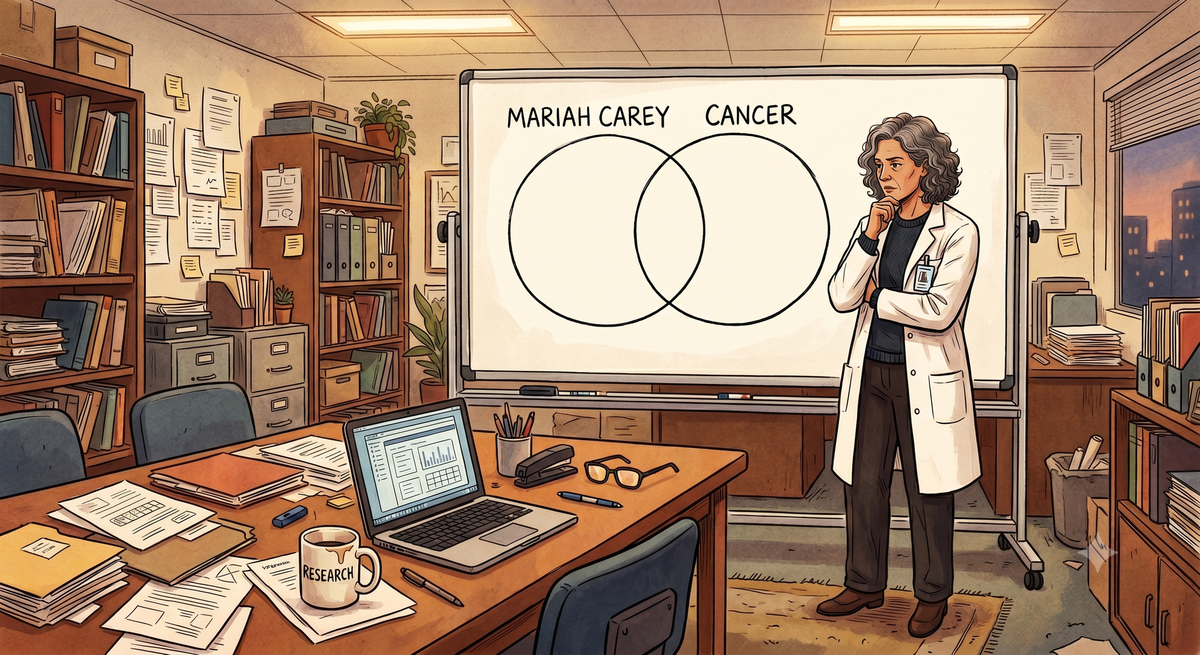
The retail application — call it MoodTune — works simply enough. Overhead cameras sample shopper facial expressions at two-second intervals, feeding a disgust-detection model trained on 40 million images of people encountering things they did not want to encounter (e.g., shit on the streets of San Francisco). When the aggregate disgust score for a given track exceeds a statistically significant threshold, the song is flagged, deprioritized, and eventually culled from rotation entirely. Mariah Carey's perennial contribution to seasonal suffering was removed from 34 pilot locations within 72 hours. The model also flagged three Michael Bublé tracks.
It is worth pausing here to acknowledge what artificial intelligence is not for. It is not for the synthesis of biological agents, the circumvention of international arms control frameworks, the destabilization of democratically elected governments, the manipulation of financial markets, the unauthorized surveillance of private citizens, or the generation of disinformation at scale. It is for determining, from lift ticket tier, GoPro mount count, lodge beverage selection, and observed stance at the top of a black diamond run, which skier will require extraction before 11am. These are the terms. They are not negotiable.
We recognize that this technology carries profound ethical responsibilities. The models described in this document were developed with careful attention to bias, privacy, fairness, and the long-term flourishing of human society. We did not undertake this work lightly. We thought about it for quite some time. Several meetings were held.
A separate system has been trained on 30 years of homeowner association correspondence. Its purpose is not to moderate disputes or streamline governance. Its purpose is to assign each communication a score reflecting where it falls on the continuum between mild disappointment and the kind of controlled fury that will eventually result in a certified letter from an attorney. The model achieves 91% accuracy at predicting, from letter three in a sequence, whether a dispute will resolve peacefully or culminate in a municipal code violation. The training data required remarkably little annotation, Judy.
The origin of this dataset traces in part to a single incident on the 4800 block of Sycamore Drive, involving a resident hereinafter referred to as Fred Granger, two and a half shots of Maker's Mark, and a tape measure that did not belong to him. The property line in question was off by four inches. The correspondence it generated over the subsequent nineteen months constitutes 38% of the model's highest-confidence training examples.
A related computer vision system can examine aerial photography of any residential neighborhood and identify, with high confidence, which fence extension, driveway widening, or landscape improvement was installed not for any functional reason but in direct response to something that happened at a block party. The model's confidence interval narrows considerably when the improvement appears within 90 days of a documented neighborhood gathering. It narrows further when the property in question is on Sycamore Drive.
Meanwhile, AI is modeling protein folding, enabling drug discovery at a scale that would have required decades of laboratory work. It is also being deployed at scuba diving operations in the Cayman Islands, where a model processes wetsuit brand, dive computer price, and the content of pre-dive boat conversation — specifically the ratio of time spent discussing previous dives to time spent discussing recently acquired gear. Divemasters in the pilot program have reportedly stopped making their own assessments entirely. The model's confidence scores, they note, are more honest.
This post was co-authored with Claude, a large language model trained on top of billions of dollars of datacenter infrastructure and GPUs, built by some of the finest engineers on the planet to serve purposes of genuine and transformative consequence. I was telling him jokes.
This is what we did with them.